Danielle SeeWalker, Húŋkpapȟa Lakȟóta, Standing Rock Sioux Nation, b. 1983
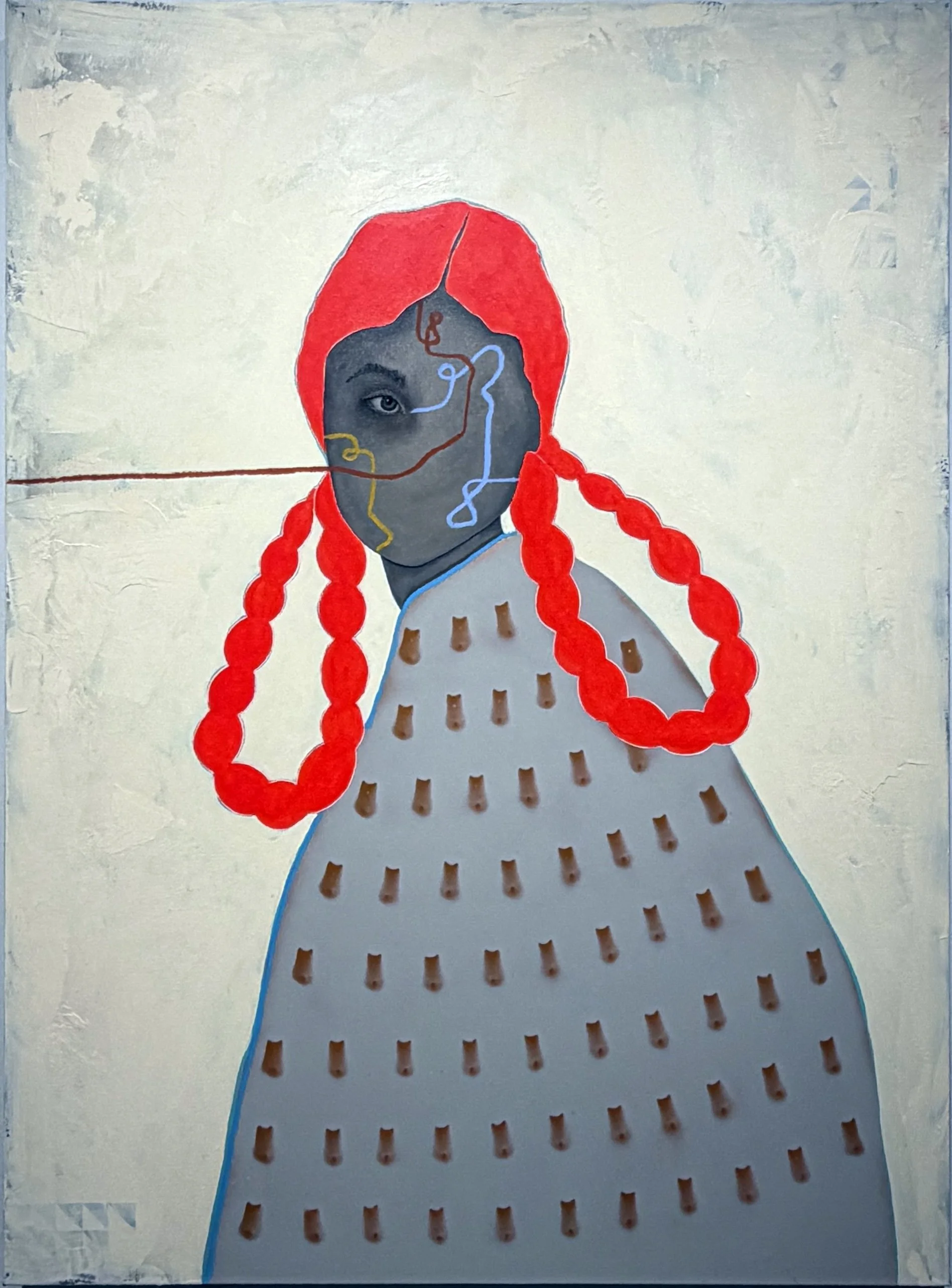
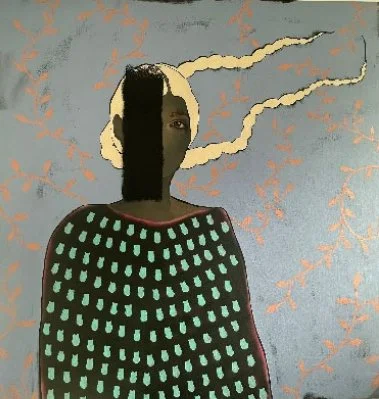
Temp. image. Higher res coming soon.
She Was Told Never To Whistle At Night, 2026. Acrylic, aerosol, oil stick on canvas. On View: Murray-Herrick Campus Center, 2nd Floor.
They Keep Trying to Erase Me, But It Won’t Work, 2025. Acrylic, aerosol, oil stick on canvas. On View: Schoenecker Center, 2nd Floor.
-
In our Lakota ways, our elders would tell us to never whistle at night as it attracts bad spirits and maybe even the čičí (bogeyman). - She Was Told Never To Whistle At Night (2026)
——————————————————
Both paintings were part of her 2025 exhibition Uŋči Said So, this work, along with the other works in the exhibition, honors the matriarchs (Uŋči is Lakota for grandmother) who held their nations together through colonization, erasure, and generations of attempts to silence them. Throughout the exhibition, the quiet power of grandmothers is uplifted: women who do not need titles to lead or permission to resist, and who understand that sovereignty begins at home. Their stories, teachings, and discipline shape the younger generations.
Her signature portrait paintings create a deliberate tension through expressionist surfaces, bold colors, and touches of realism. The distinctive eyes of her subjects draw viewers in, establishing the tone, emotion, and narrative of each work. Intimate, directive, and sometimes wry, their gaze invites viewers into stories that are both personal and communal. Pops of fabricated neon featuring res slang and cultural gestures add a playful, contemporary glimpse into Indigenous humor and identity.
Source: All My Relations Gallery, “Uŋči Said So” (2026).
-
My work over the past decade has used the revealing aspects of American Indian history, as told from the perspective of a Native American person, to demonstrate the profound impact it has had on our contemporary cultures today. In the current climate, where many believe history has no relevance, or believe Native Americans are relics of the past, I find myself continually returning to those aspects that are often hidden or misrepresented in the “official” recordings for posterity. In my multidisciplinary and diverse approaches to making art through installations, studio work, public street art, murals and curatorial work, I want the context of the work to leave the viewer with a thirst for wanting to know more.
My current body of work is very diverse. I have recently completed several murals for various mural festivals, private commissions and public art projects. As the colder months approach, I shift my time to studio work where I have been working on a series of portraits titled “The Braided Women” which tells stories of my people and culture from a Lakota woman’s perspective. Recently, I concluded a few exhibitions on the East Coast in Boston, Philadelphia and New York City and am shifting gears to install a couple murals in Palestine and Kenya this year along with preparing for another solo exhibition in Las Vegas.
Danielle SeeWalker, 2026
-
Danielle SeeWalker is a Húŋkpapȟa Lakȟóta citizen of the Standing Rock Sioux Nation in North Dakota. She is a mother, artist, muralist, writer, curator, activist and businesswoman and is currently based in Denver, Colorado. Her visual artwork often incorporates the use of mixed media and experimentation while incorporating traditional Native American materials, scenes, and messaging. Storytelling is an integral part of her artwork and pays homage to her identity as a Lakȟóta wíŋyaŋ as well as her passion to redirect the narrative to an accurate and insightful representation of contemporary Native America while still acknowledging historical events.
Alongside her work as a visual artist, Danielle is a freelance writer and published her first book in 2020, titled “Still Here: A Past to Present Insight of Native American People & Culture.” She is also very dedicated to staying connected and involved to the Native American community including serving 5 years on the Denver American Indian Commission with two of those years serving as Co-Chair. Through her work on the Commission, she has been able to be involved in policy work that has directly affected her Native American community – including legislation to abolish derogatory Native American mascots in schools (2021) and to create an Office and Liaison for Missing & Murdered Indigenous Relatives (MMIR) investigations (2022 and 2023). Danielle considers herself a “artivist” as she is able to voice many important topics through her artwork but also be boots on the ground to make change happen.
Danielle has also been working on a long-term personal project since 2013 with her long-time friend called The Red Road Project. The focus of the work is to document, through words, photographs, and video, what it means to be Native American in the 21st century by capturing inspiring and positive stories of people and communities within Indian Country. She recently evolved that project into a non-profit organization with a division to provide cultural arts opportunities to Native American people residing in urban areas.
In 2022, Danielle was the recipient of the Mayor’s Excellence in Arts & Culture Innovation Award and in 2024 received an Emmy Award for her work on a documentary piece with Rocky Mountain PBS called “A New Chapter”. In 2025, Danielle received the NDN Collective’s “Radical Imagination Grant” to support a collaborative project with Palestinian artists and is the 2026 Greene Fellowship recipient.Danielle SeeWalker seewalker.com
Other Indigenous Artworks on view, 2nd Floor Murray-Herrick Center
Danielle SeeWalker
George Morrison
Jaida Grey Eagle
Johnathan Thunder
Mikayla Patton